
Celestial and Earth-sky horizon
The app can calculate sunrise for two kinds of horizon. Vaishnavas use the Celestial one — and here is why.
The difference, with an example
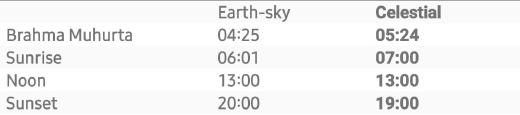
- 6:01 — sunrise on the Earth-sky (visible or local) horizon;
- 7:00 — sunrise on the Celestial (astronomical, true) horizon;
- 13:00 — noon, the same for both;
- with the Celestial horizon, daytime = night time = 12 hours.
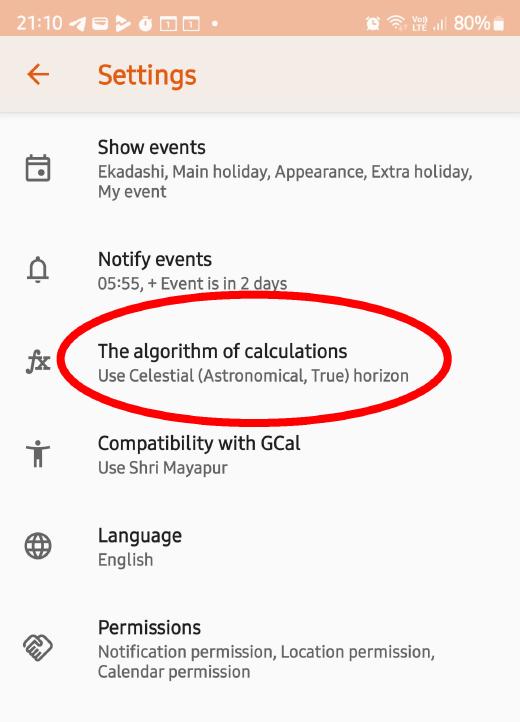
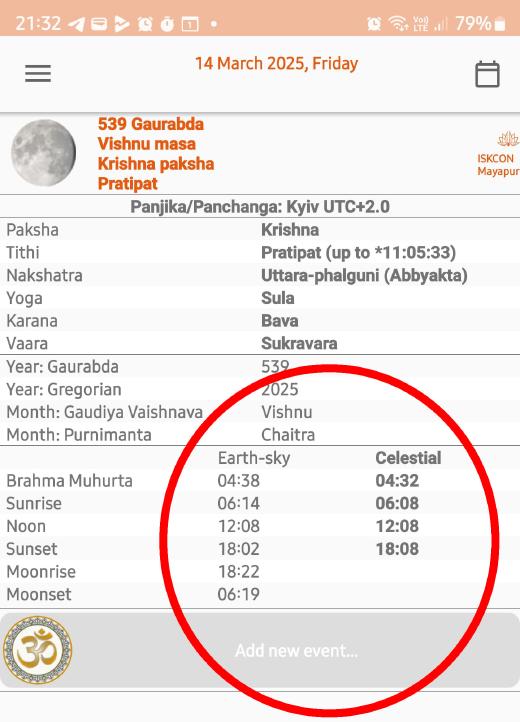
What is the Earth-sky horizon?
The local, or geometrical, horizon is the visible boundary between the Earth and sky. It may include trees, buildings and mountains. The geographic horizon is the apparent boundary between Earth and sky without such elevated features; the sea-level horizon is the geographic horizon at sea level — on a beach, the ocean and the sky give a clean, flat line where the Earth seems to meet the sky. Read more on Wikipedia.What is the Celestial horizon?
Astronomers use celestial horizons to measure positions relative to the rest of the sky. The celestial horizon is a plane through the centre of the Earth, perpendicular to the zenith–nadir axis; the visual horizon approaches this plane at the Earth’s surface. The astronomical horizon is the type whose horizontal plane is always at 90° from the observer’s zenith. The true (or rational) horizon is the theoretical plane through the centre of the Earth; from orbit it follows the shape of the Earth. Read more at National Geographic.What do the Vaishnava scriptures say?
Daytime equals night time: daytime ~12 hours, night time ~12 hours, so the whole day is 12 + 12 = ~24 hours.
The short proof
CC Madhya 20.390, translation by His Divine Grace Śrī Śrīmad A. C. Bhaktivedānta Swāmī Prabhupāda:
The day and the night are divided into eight praharas — four belonging to the day and four belonging to the night. After eight praharas, the sun rises again.
- Daytime (4 praharas) = night time (4 praharas)
- Daytime (12 hours) + night time (12 hours) = day (24 hours = 8 praharas)
- prahara ≈ 3 hours
In the example above, daytime starts at 7:00 (sunrise) and ends at 19:00 (~12 hours); night starts at 19:00 and ends at the next sunrise (~12 hours).
Further references
How can day and night be equal?
When are daytime and night time both 12 hours?
First, there are always twelve hours of daytime and twelve of night time at the Equator (more). Second, the dates on which day and night are each 12 hours fall a few days before and after the equinoxes (more). Finally, Vaishnavas use the Celestial horizon for calculation, which makes daytime and night time always equal.Conclusion
Vaishnavas follow “daytime equals night time, 12 hours each” by using the Celestial horizon option. Most calendars calculate sunrise with the Earth-sky horizon — when the sun’s limb appears on the horizon. This app does so only if you choose that option.