
Features
What the Vaishnava Calendar for ISKCON shows and how it calculates it.
Month view
- current day and Tithi;
- Ekadashi fasting and Parana (time of breaking the fast);
- Purnima (full moon) and Amavasya (new moon);
- Vaishnava holidays;
- your own events — birthdays and so on.
Day view
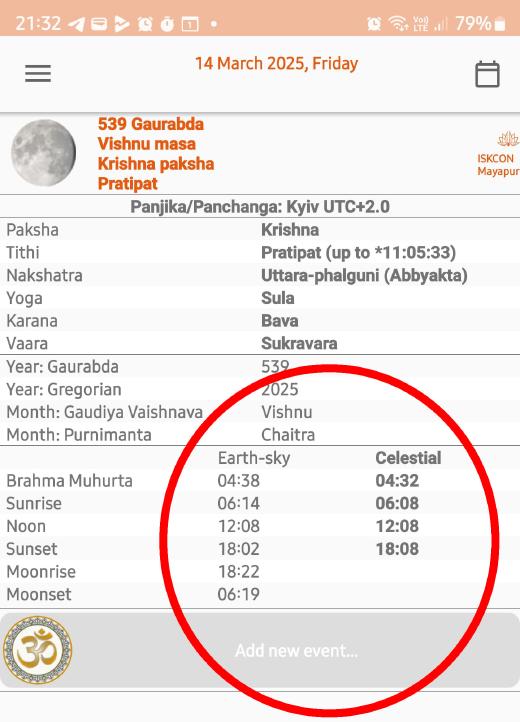
Hindu calendar — Pañcāṅga / Pañjikā: Tithi (with end time), Paksha, Nakshatra, Yoga, Karana and Vaara.
Years and months: Gaurabda, Chandra varsha and year; Gaudiya Vaishnava masa and Purnimanta masa.
Daily timings: Brahma Muhurta, sunrise, noon, sunset, moonrise and moonset.
On Ekadashi vrata days, additionally: when fasting begins, the period of breaking the fast, and a description of the Ekadashi.
On Vaishnava holidays, additionally: a description and information about fasting.
Rules and standards
Navadvīpa Pañjikā
The app follows the rules given by Śrīla Bhaktisiddhānta Sarasvatī Ṭhākura in his Śrī Navadvīpa Pañjikā, written to cultivate Śrī Harināma-saṅkīrtana worldwide. The Pañjikā itself was designed according to the Vaiṣṇava smṛti Śrī Hari-bhakti-vilāsa by Sanātana Gosvāmī.
Full support for ISKCON
Both ISKCON algorithms are implemented:
- using Mayapur (near Navadvīpa, West Bengal, India);
- using the current location.
That covers both standards: before 1990 and after 1990. The first was established by the Founder-Ācārya, His Divine Grace A. C. Bhaktivedānta Swāmī Prabhupāda, and was widely used in ISKCON until 1990 — Śrī Māyāpur is the reference location that decides on which day Vaishnava events are celebrated around the world. In 1990 the second standard was proposed: use the current location instead.
Only Vaishnava Ekadashi
Only Vaishnava (Bhāgavata) Ekādaśī that are śuddhā (pure) are supported: Daśamī, the tenth day of a lunar fortnight, must end before Aruṇodaya — the 96 minutes before sunrise on Ekādaśī. Smārta Ekādaśī are not supported (they are available in any Hindi calendar).
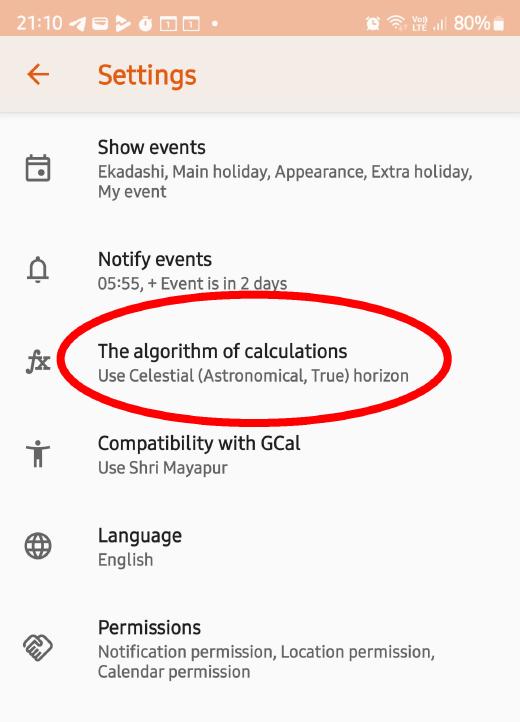
Horizon and ayanāṃśa
- Horizon: Celestial (astronomical, true) or Earth-sky (visible, local) — see how they differ.
- Configurable value of ayanāṃśa.
Places and languages
- built-in database of 4,000 cities to choose the current location;
- Daylight Saving Time (Summer Time) for Europe, USA and Australia;
- 12 languages: Hindi, Bengali, English, Ukrainian, Portuguese, Spanish, Italian, French, German, Dutch, Russian, Hungarian.
Export events
- Google Calendar — with cloud synchronization, so you can use your favourite widget;
- Local / offline calendar — without cloud synchronization;
- Clipboard — for saving to a CSV file and importing into MS Outlook/Exchange, Yahoo or Google.
Trust the numbers
The astronomy behind the dates has been checked against the JPL DE421 ephemeris — see the accuracy report.